
SBI Life Insurance is in the process of seeking permission from foreign regulators to sell its products to Non-Resident Indians through the overseas branches of the State Bank of India.

'The correction could take two to three months and traders need to be careful.' 'For investors, this could be a good time to nibble in.'

The market breadth, indicating the overall health of the market, was positive

Independent market analyst Ambareesh Baliga points out the red flags that retail investors should not have ignored and lists three scenarios -two of these scenarios offer a glimmer of hope to retail shareholders of Yes Bank - that could play out in the coming days.
Terming the home loans package of PSU banks highly inadequate, Assocham President Sajjan Jindal demanded that the government peg the interest rate on housing loans up to Rs 30 lakh at 6% and at 8.5% for loans above this amount.
The government has cleared a second round of voluntary retirement scheme for shedding 10 per cent of the total workforce of public-sector general insurance companies involving a cash outgo of Rs 1,000 crore.
Here are the highlights of the economic package announced by the government on Sunday.
Recent rates cuts by most banks may not have a significant impact on margins, say analysts.
Foreign institutional investment flows remain key driver for the Indian markets.\n

IndusInd Bank, Kotak Bank, ICICI Bank, Sun Pharma, Bajaj Finance and Ultratech Cement were prominent gainers. NSE Nifty rose 176.65 points to 14,867.35.

The policy was part of the Aatmanirbhar Bharat package announced by Sitharaman in May 2020 as a coherent policy where all sectors would be opened for private sector participation.

'If the RBI blesses us with a banking licence, we would like to launch a successful bank.'

The market rally was driven by strong buying in telecom, banking, realty, metal, FMCG and PSU counters.

The 50-share Nifty scaled a high of 10,207.90 intra-day but succumbed to profit-booking to finish at 10,184.15, up 53.50 points

The banking sector's credibility is on thin ice. Unless the government takes strict steps, things could get worse.
India's state banks are under pressure to improve profitability.

The National Company Law Appellate Tribunal has directed the new board of the debt-ridden IL&FS Group to distribute Rs 16,361 crore of cash and InvIT units available across the Group to its creditors on pro-rata basis. The interim distribution award of Rs 16,361 crore includes Rs 11,296 crore in cash and Rs 5,065 crore in InvIT units (Infrastructure Investment Trusts) and a majority of this is to be distributed to the creditors of three large group firms -- IL&FS, IFIN and ITNL. "The interim distribution shall be confined only to the entities as reflected in Annexure-6 except those excluded and for the amount of Rs 16,361 crores i.e Rs 11,296 crore of cash and Rs 5,065 crores of InvIT Units," said an order by a two-member NCLAT bench headed by Chairperson Justice Ashok Bhushan.

So which sectors are likely to do well in 2022? Should you focus on domestic economy-related sectors or export-oriented ones?

M&M was the top gainer in the Sensex pack, soaring around 7 per cent, followed by Bajaj Finserv, Bharti Airtel, PowerGrid, Infosys and ICICI Bank. On the other hand, HUL, Kotak Bank, Bajaj Finance and ITC were among the laggards.

If a name does not unify the three, there could be continued clash of identities, which could splinter the brand even before it takes shape, say Abhijit Lele and Nikhat Hetavkar.

Since the beginning of 2020, i-bankers have collected nearly Rs 1,800 crore by way of IPO fees. Interestingly, the India fees this year form just 1 per cent of the global fee pool of $13.7 billion from IPOs.

'Retail investors have been selling since the Budget and Foreign Portfolio Investors started selling.' 'Thus far, domestic institutions have picked up the slack, buying enough to keep the major indices from falling off a cliff.' 'However, there has been carnage in smaller stocks and the financial sector has been hit much harder than the major market indices,' points out Devangshu Datta.
Banking PSU stocks were being drubbed today following reports that the Centre may charge a premium on returned equity by these banks.

The top 100 companies have accounted for 63% of the gains (Rs 51 trillion out of Rs 81 trillion), while firms beyond the top 100 have contributed 37 per cent (Rs 30 trillion).

Laggards yet, a number of smaller PSBs in the category have balance sheets which do not give much comfort.

Ask rediffGURU and tax expert Mihir Tanna your income tax-related questions.
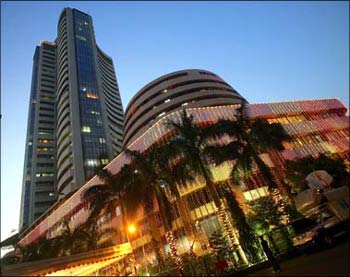
'There is no change in the overall story of economic recovery.'
Five ratios you must know before putting your money into banking stocks.

'The revenue projection arises out of all sectors doing well and the formalisation of the economy helps in making sure the tax domain gets widened.'

Banks cannot shirk their responsibility in cases of frauds.

Banks in India must have a modern approach, suggests a panel comprising of banking bigwigs.

The laggards include FMCG (16 per cent), Energy (37 per cent) and Media (34 per cent).

'While GST and demonetisation are likely to cause disruption for longer than the market currently expects, they can have meaningful positive impact over the medium-term.'

'This is not just the IREDA's IPO. It is the success of the ministry of new and renewable energy and of the renewable energy industry.'
As of December 2014, NPAs of PSU banks were at Rs 2,60,531 crore.

The indices closed with losses for the week, with the Sensex declining 476.14 points, and the broader NSE Nifty falling 155.45 points during the period.

The broader NSE Nifty reclaimed the key 10,000-mark and touched a high of 10,143.50 before finally settling at 10,130.65
